I have noticed the lack of vintage clothing shops with websites, especially in Nottingham. In fact none of the Nottingham based vintage clothing shops have an online presence and rely on feedback websites such as trustedplaces.com for advertisement. Cow, who are Wild Clothing's main competitor, have been in the process getting a website up and running since they opened. With this in mind I think Wild Clothing could benefit a lot especially as their main target audience spend a lot of their time online. Beyond Retro are a vintage clothing brand from Sweden. Their website incorporates sound and flash animation in a novel and stylish way. Although the first few pages are flash, they have alternative HTML versions and the rest of the site is HTML. This is done very smoothly and is a simple way of getting round all the issues that effect your SEO ranking.
Since I came across Nevo's portfolio website, I have wanted to incorporate sound on a website. From both websites it seems best used in small doses and used effectively it can prolong interest, increasing time spent on site.
Live Client: Influencial Websites
Live Client: Meeting2

In our second meeting we discussed possible domain names, hosting, CMS and also threw a few design ideas about to achieve an understanding of what could work.
From this meeting the target audience was identified as 12-25year olds with a large %age being students, and the main aims for the website where addressed:
Robin is a busy businessman who wants an easy to manage and low maintenance website which informs the user of their products and each shops details (opening times, location etc). It also must be easy to navigate and use the existing branding (logo, colours, fonts etc).
It was mentioned there was some confusion among customers, who thought wild and wilder were in competition. Therefore it is neccessary that the website should clarify that both shops were of the same brand and ownership.
The website should also identify the heritage of the shop-as it is the oldest vintage clothing shop in the city centre-and also promote the new clothing lines as well as the second-hand and customised items on sale.
It was mentioned that Wild Clothing had tried creating a group on Facebook. This was however unsuccessful and from their experiences, would prefer not to use it or similar technologies again.
The one off nature of Wild Clothing's products, mean that an online shop is not a viable option for the company, as the effort and time needed, would far out-way the profit gained. However without some form of functionality, it will simply act as a brochureware website. As this is my final piece for my degree I would like to push the boundaries slightly so I am going to present a few ideas to Robin at January's meeting along with some developed design and layout ideas.
Simulated Client : Re-Design
 From both user testing feedback and also my personal growing dislike of my previous design, I have started to redesign my anti piracy website. It is perhaps a bit late in the day for this change of heart but as I have already coded the site it will simply be a matter of changing the CSS and shouldn't take too much time.
 I started looking at PSDtuts+ website for
  some hints and came across the image to the left. Unfortunately the tutorial was only accessible to members but I have used it for inspiration. I have noticed a lot of use of the texture on the ladies face, and the use of collaged photographs goes along the same theme of my previous design, as well as being a common trend at the moment.
Below are some of my initial designs.

Client Project: Design Influence
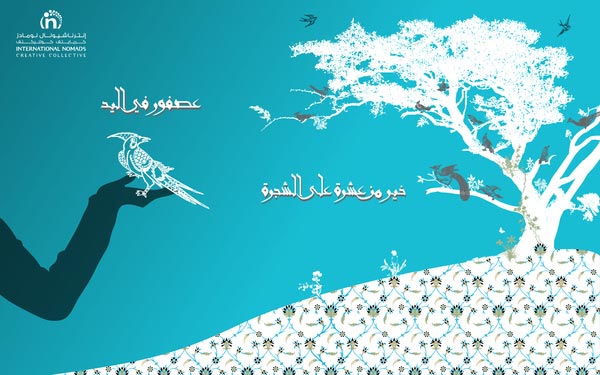
All of these artworks are from an article entitled "100 Artworks from the Top 20 Designers in The Middle East and Africa" on the psdtuts+ website. Recently I have been disliking my anti-piracy website design more and more, so viewed these to seek inspiration to develop my designs further.



PRP: Trends in Creative Industries
Listen to Podcast
Kevin Wheeler who is the Chairman of the Future of Talent Institute talks about Richard Florida who is a professor in Canada and wrote "The Rise of the Creative Class" in this book Kevin says he "claims there are about 38 million people right now in the creative class in the United States, and they are generating more wealth, by his estimation, than any other group in the United States and in the world".
Kevin also says that "if you want to attract a creative class type of person, you're going to have to have an organization that meets some raw criteria, I think it's have to be, it can't be rigid, it can't be hierarchical, and it can't be rulebound, so I think that's a real challenge for many large companies [...] I think they already are, being very challenged with finding and being able to actually hire the very best of these creative people."
Kevin mentions a very interesting and -for many- surprising point: "the fact that women are now dominating the workplace pretty much globally, two out of three college degrees are going to women globally, women are for the first time in America now dominating the workplace, there's more women working than men, and this recession has been pretty much a "hecession"—it's only affected men for the most part, the vast majority of people laid off have been men, very few women, so this is going to have a major impact on the nature of work"

PRP: Methods EA Use to Maximising Performance
Jeff Hunt the Senior Director of Electronic Arts University and EA. He talks to Steve from Business Execution Radio, about how they maximise performance in their highly creative workforce. Below are some key points made that relate to my Dissertation question.
Jeff: "EA was in the space for a long long time where we were by far the most successful company in the market, [...] well, now it’s more a competitive marketplace, there’s been a lot of technical transition, etc, and so [...] the question really comes down to, how do we help prepare our managers to be, to produce these great results while looking at a more competitive marketplace, Wall Street’s demanding more, etc, and so EA University has really put a focus on helping managers navigate that change and that transition."
Jeff: "We’ve actually created some social networking tools inside of EA, and we have very much tried to foster people’s use of those. They’re rudimentary compared to what’s generally available on the web, like Facebook and LinkedIn and others, but they do give people an ability to create a presence inside the organization and talk about who they know and who they’re connected to, and what kind of work they do together".
Steve:"That’s a great example, it sort of summarizes, it sounds like the key to maintaining this healthy tension in relationships really comes back to making sure people have agreement on, these are our shared goals, this is what we’re trying to accomplish, that we’re having these debates back and forth, that kind of, we can come back and use, which of this is moving us towards the goal that we’ve all agreed to, but the recognition that those goals needs to be revisited constantly, you can’t just set the goal at the beginning of the year, and then assume everybody remembers what it was, because it probably evolves over time. "
Alternative ideas
This image gave me the idea for a possible alternative interactive element and could be quite effective on a welcome page. The parrots could be animated in a similar composition to the picture and be shouting insults. It doesn't go along with the approach I want however could be quite funny!

Simulated Client: Font embedding
For my simulated client's website, I would like to use a font replacement technique as the choice of fonts supported by browsers is limited. Often simple image replacement is used, positioning the text off-screen and replacing it with an image. Although in most cases this is ok, there are many possible problems linked to this technique. To get around such problems there is a technique called non-standard font embedding and I am looking into the different methods to see which is best for this situation.
"The thing with non-standard font embedding techniques is that they mostly rely on JavaScript and sometimes Flash or PHP to render text in whatever custom font is specified. Thus, choosing the right solution for a web project can become tricky[...]


Typeface and Cufon are the most promising beign the easiest to setup. On the other hand they are both plagued with licensing issues and lack of ability to select text, which for many can be a deal breaker. This appears to be changing though, as Type Select builds on top of typface.js and promises text selection functionality. Still, it is a relatively new player and is also plagued by limitations such as lack of support in IE and no support for :hover and line breaks." View article for list of pro's and cons.