Organisational Socialisation: "typically defined the process through which individuals acquire knowledge about and adjust to their work context"
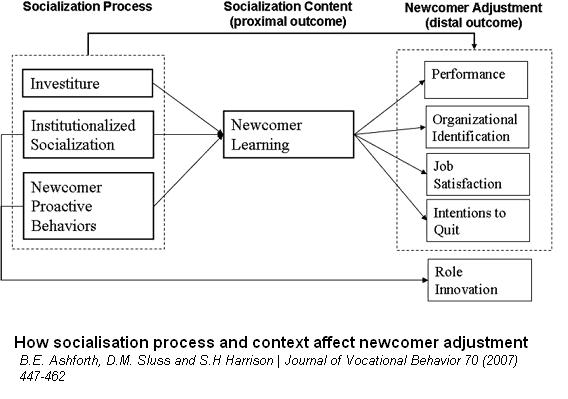
Socialisation Content: "the substance of what an individual learns (or should learn) in order to become a proficient and comfortable member of the organisation"
Social Information: "about other people and one's relationship with those people"
Normative Information: "about the organisations culture"
Knowledge Acquisition: "reduces newcomers' uncertainty and role ambiguity"
all quotes from Socialization tactics, proactive behavior, and newcomer learning: Integrating
socialization models by Blake E. Ashforth a, David M. Sluss & Alan M. Saks
Showing posts with label Year3 PRP. Show all posts
Showing posts with label Year3 PRP. Show all posts
0
PRP: HR Definitions
0
PRP: Artefact#6: Newbie Integration Development
 The Effectivenes of an Organizational-level Orientation Training Program in the Socialisation of New Hires
"employees attending the orientation training were significantly more socialised on 3 of the 6 socialisation content dimensions(goals/values, history and people)"
"the people dimensuin of socialisation which was significantly related to the orientation attendance[...] having a better understanding of the history, traditions and values of the organisation may have helped new employees engage coworkers in discussion, join in on others conversations, and be more quickley accepted"
SOCIALIZATION TACTICS AND NEWCOMER INFORMATION ACQUISITION by
Alan M. Saks* and Blake E. Ashforth
"According to Miller and Jablin (1991) newcomers' acquisition of information might be strongly affected by the way the organization socializes newcomers. In fact, in a study on the antecedents of newcomers' communication behaviour, Mignerey, Rubin and Gorden (1995) found a direct positive link between institutionalized socialization tactics and information/feedback-seeking behaviour. Thus, newcomers' opportunities to acquire information during socialization might depend on socialization tactics. Therefore, if one of the major functions of socialization is to provide newcomers with information (Louis 1980) it is important to understand how this is most likely to happen."
"feedback and observation). According to Mignerey et al. (1995) institutionalized socialization tactics `provide a structure that enables newcomers to communicate more readily with coworkers and superiors. With such a structure in place, newcomers are better able to obtain information about the organization and reduce the uncertainty associated with assimilation into a new work environment' (p. 77). Thus, institutionalized socialization tactics are predicted to be related to more frequent information acquisition because they provide newcomers with formalized and structured opportunities to interact with insiders, whereas individualized socialization is more informal and reflects a relative absence of structure (Ashforth et al. 1996). With individualized socialization, newcomers may have little or no access to other newcomers and insiders, at least not through formal or structured mechanisms. On the other hand, newcomers who experience a collective (versus individual) socialization are likely to have more formalized opportunities to interact with other newcomers and to observe and acquire information from them. Serial (versus disjunctive) socialization can be expected to provide newcomers with more formal and structured opportunities to interact with and observe coworkers and supervisors who have experience in the newcomer's role (Ashforth and Saks 1996). Thus, because institutionalized socialization tactics involve more information-laden experiences (Allen and Meyer 1990; Jones 1986) provide newcomers with formal opportunities to work with and interact with insiders, and reflect a more structured programme of socialization (Ashforth et al. 1996; Mignerey et al. 1995)"
0
PRP: Artefact#5 Newby Integration
"The greatest havoc comes when a firm is unable to integrate new people into the culture of the firm," claims Robert M. Dell, leader of the law firm Latham & Watkins. It can be disruptive to introduce new capabilities and personalities to an established and well functioning group. With each addition, the group's requirements for communication grow exponentially. The addition of even one new member requires that the entire team regroup and rebond, finding new ways of working and ultimately recreating their dynamics and working style.
It takes time and effort to integrate a new team member. Without it, the new member may (and indeed, often does) flounder, become isolated, create conflict, or worse. While some firms may try (even in this day and age) to rationalize a sink-or-swim philosophy with junior people, most firms cannot afford the internal and external impact (not to mention the costs) of people coming and going with frequency.
After all, you're not just hiring a warm body. In most cases you're adopting a new colleague, or someone you expect has the potential to become a colleague, into your family. With a little thought and attention you can take steps to ensure that these new hires don't take a good look behind the curtains and head back onto the open market.
Initiatives to Integrate New Additions
Here are some steps to integrate new additions:
1. Manage first impressions
2. Give them support - before they ask
3. Make them feel valued
4. Provide an immersion experience.
5. Communicate, communicate, communicate.
1. MANAGE FIRST IMPRESSIONS
First impressions are critical. Design an orientation program that provides information to people as soon they arrive. Remember to introduce your group to the new person and the new person to the group.
One practice team greets new people by having their photos taken and affixed to a large sheet of flip-chart paper that also displays the personal answers to two questions in the new people's own words: my most gratifying personal achievement and my most important transaction. The sheet is then posted on the boardroom wall at the group's next regularly scheduled meeting.
A simple memo from the group leader (distributed on the day of their arrival) welcoming new people and sharing pertinent details (where they came from, what they do, their credentials, new office location, secretarial assignment, etc.) can do wonders. Suddenly everyone in the group knows enough to say "hello" and "welcome."
2. GIVE THEM SUPPORT - BEFORE THEY ASK
New people require a clear understanding of their group's expectations. They also need introductions to specific people that can support their aspirations, training on the equipment and systems they may need, and a tour of the facilities. Someone must invest the time necessary to make them feel welcome. It is up to the group leader to organize this.
The executive director at one consulting firm invested in a staff coordinator whose task was to spend one-on-one time with new additions during their first days in the office. She trains them on the telephone system, explains firm resources, shows them how to access the computer network, makes introductions to staff members with whom the person will interact, talks through office kitchen protocol, and answers the myriad of seemingly trivial questions no one would wish to ask the person in the next office.
0
PRP:Artefact#5_Newby Integration
Previous artefacts have provided me with evidence to prove that people are much more willing to participate in Knowledge Management Initiatives when they know the people in the group and have a social support network. This teamed with being a new starter in a creative company myself, has lead me to think about the integration of new starters.

Being new anywhere provides problems such as learning colleagues names, understanding their job roles and the running of the company as a whole. In small companies where there are less than 10 employees this may not be such an issue, but more than this can become 'information overload'.
For my Final Artefact I am proposing to make an online application/website that addresses these issues. Currently I see this as a list of pictures, along with names, job roles and internal contacts such as telephone extensions and email addresses.
A version of this could be added to a company's website for a more personal approach and useful for clients to put a face to a name when in correspondance. I am looking at ways that this could be useful for existing staff and this could shape my 5th Artefact as I have skipped ahead!
0
Click here for tour
PRP: Base Camp
 BaseCamp is a online Project Management tool that enables a group of individuals to achieve a understanding of what stage a project is at quickly and efficiently. This is a really good tool for any project, allowing you to share files, set milestones and make to do lists. This could be a much more efficient way of running any project and potentially a more successful alternative to the forum we are currently using to plan our exhibition.
A focus on communication and collaboration. Basecamp brings people together.
Some free alternatives:
BaseCamp (30 day free trial)
Copper Project(30 day free trial)
Teamwork (free forever) 5MB 2Projects unlimited users
Comindwork 20MB 1 Project
More information available at PM Sherpa
0
PRP: Artefact4_online chat room

For Artefact 4 I am interested in how people are much more likely to talk to strangers online compared to face-to-face. Online communication provides a safer, more familiar environment, which can evoking more honesty and also interaction between people that may not know one another.
Jump back in time
Read past chat transcripts anytime you want. Campfire keeps a history.
(This will allow me to analyse the communications that occur)
Basecamp integration
Use Campfire with Basecamp, the leading web-based project collaboration tool.
Currently meetings and an online forum have been set up to facilitate discussion concerning our course exhibition and limited involvement from many of the course members has proved to be an issue.
Combining both of these factors I am curious to see whether staging a exhibition meeting online would help this problem. I found Campfire through participating in a Chat Room set up by Erskine Design.
WHAT IS CAMPFIRE?
Campfire is a web-based group chat tool that lets you set up password-protected chat rooms in just seconds. Invite a client, colleague, or vendor to chat, collaborate, and make decisions. Link to a room on your intranet for internal communications.
Live image previews
Upload a GIF, JPG, or PNG, and it shows up right in the chat room.
(Quite handy when discussing catalogue and website designs)
Campfire is a web-based group chat tool that lets you set up password-protected chat rooms in just seconds. Invite a client, colleague, or vendor to chat, collaborate, and make decisions. Link to a room on your intranet for internal communications.
Live image previews
Upload a GIF, JPG, or PNG, and it shows up right in the chat room.
(Quite handy when discussing catalogue and website designs)
Jump back in time
Read past chat transcripts anytime you want. Campfire keeps a history.
(This will allow me to analyse the communications that occur)
Basecamp integration
Use Campfire with Basecamp, the leading web-based project collaboration tool.
(If we were to Use BaseCamp this could encourage more participation)
0
Following my 3rd artefact I am going to utilise our Exhibition Meetings to test the theory put forward by this presentation.
Exhibition Meetings are currently being carried out face-to-face in the standardised meeting format. These have been working okay but there have been problems with involving everyone on the course and also getting constructive critism of ideas put forward.
With this in mind I am interested in using online technologies (Chat Room) for our next Exhibition meeting. I am hoping that this will be successfull as all members are affected by this topic of discussion and also by achieving a more detached environment, more honest comments will occur.
PRP: Artefact#4
Project innovation through effective Internal Communications
This presentaion theorises that more successful and efficient communication can occur using online technologies such as Instant Chat Software. They use an example from a work environment where a group of colleagues have an idea that they think will benefit the company and want to present this to their boss. The online Chat system allows them to share links to articles, video's etc that could be useful to the presentation instantantly rather than waiting for the next day.View more presentations from Knowledge Solutions.
Following my 3rd artefact I am going to utilise our Exhibition Meetings to test the theory put forward by this presentation.
Exhibition Meetings are currently being carried out face-to-face in the standardised meeting format. These have been working okay but there have been problems with involving everyone on the course and also getting constructive critism of ideas put forward.
With this in mind I am interested in using online technologies (Chat Room) for our next Exhibition meeting. I am hoping that this will be successfull as all members are affected by this topic of discussion and also by achieving a more detached environment, more honest comments will occur.
0
Another paper entitled Stimulating the Potential: Creative Performance and Communication in Innovation Teams by J Kratzer, R Leenders and JML Engelen states that although levels of communication can have a positive affect on team innovation; like most things too it has an optimum and:
I will time and record both using a video camera. I won't be in the room either but close by to answer any questions and guidance if needed.
My aim is to see if the group of acquaintances get easily distracted or instead want to complete the task quickly so they can get it out of the way. I will also analyse the footage measuring levels of interaction.
PRP: Artefact#3 Research

It suggests that a solution to this problem is in achieving good relationships which act as a social support network.
"Often, the capacity of interpersonal channels to provide social support and enhanced confidence in the outcomes of the innovation can be crucial in innovation implementation."
(L.A. Fidler and J.D. Johnson, 1984)
Another paper entitled Stimulating the Potential: Creative Performance and Communication in Innovation Teams by J Kratzer, R Leenders and JML Engelen states that although levels of communication can have a positive affect on team innovation; like most things too it has an optimum and:
- "high frequency of communication (more than the necessary minimum) tends to decrease the creative performance of innovative teams"
(J Kratzer, R Leenders and JML Engelen, 2004)
- "for each team member it is equally important to be provided with sufficient information."
(.ibid)
I will time and record both using a video camera. I won't be in the room either but close by to answer any questions and guidance if needed.
My aim is to see if the group of acquaintances get easily distracted or instead want to complete the task quickly so they can get it out of the way. I will also analyse the footage measuring levels of interaction.
0
PRP: Creating a Facebook Application
For my next artefact I am thinking of clinking my pig website to facebook. This youtube tutorial provides the step by step process of creating a facebook application. I'm sure it sounds easier than it is!
0
PRP: Artefact#2_Help the Pig
 Here are screen shots of my pig website, created for my second artefact.
The homepage gives the user(left to right): instructions and input form, pig animation, and the jokes and comments submitted in the last 24 hours.
The animation changes according to number of posts in the past 24hours to portray the health of the pig. He  goes from being happy and healthy and rolling in mud, to being cooked on the spit roast. Its health status is also reflected by the bars above.
Similar to Facebook, comments and jokes can be ‘liked’.
The About Page explains more about the functionality of the site and also its purpose. Users can contact be  through the ‘Contact Jacqui’ form.
Jokes and feedback can also be submitted on the left hand side on all 4 pages.
The Joke and Comments pages display all the jokes or comments submitted since the beginning of the project. Both types of submissions can be ‘liked’ here.
The website has now had a make over...
Help the Pig!
0
Google Anaytics: Track IP
I have attached a Google Analytics Account to my piggybank website and I wanted to illiminate my own visits to the site to create a fair representation of stats. I have done this by replacing the body tag with a small line of code. Blogger won't let me post it as it recognises is as code so click here to find the code mentioned in the video below.
0
PRP:Artefact#2_Piggy Bank

From this I found that the colleagues of small organisations have no need for using online social networking if they work in close proximity and in an environment where communication is sufficient.
A requirement of the course is that I make something using my multimedia skills, and develop it using my findings.
As my research project is business based; I have found it hard to come up with a solution to this dillema. But today after a chat with my lecturer I have an idea. This idea is to use a character to represent a business. Users must complete simple tasks regularly (upload images, answer questions, submit jokes) to keep the character healthy. All this info will be displayed on other pages to keep a sense of shared knowledge.
0
PRP: Artefact#1 Evaluation
The aim of my first artefact was to find examples of where online social technologies have been encouraged to determine what methods are most successful.
I was expecting to find that higher levels of innovation and creativity can be achieved from the use of online social technologies i.e. successful companies utilize online technologies.
My research took the form of a telephone interview. I sent an email to a range of Nottingham based design agencies and then followed up this email with a recorded phone call, using a Dictaphone.
At Absolute Design, the employees are contracted to full time positions where they work standard office hours and in-house. Employees work in close proximity and are able to communicate easily and sufficiently face-to-face. A shared understanding is gained by board meetings and so it is unnecessary for relations in a work context to be built online. Blogs are too informal for their and their clients needs and a dedicated page on there website is a preferred method as it exists linked to company’s website unlike a blog.
I found that creative organisations are extremely aware of the importance of communication, negative implications of vertical hierarchy and also the influence the work environment has on employee creativity.
I found the lack of online technologies quite surprising, considering the nature of Absolute Design’s work and as the internet enables people to work from home. However, I have come to realise that it is both obvious and logical that employees won’t continue working when not at work and especially when they work in small numbers and in close proximity.
From these findings my research will focus on alternative avenues where online technologies are useful to a smaller creative organisation. This may involve companies that use business networking sites, freelancers or employees that work from home.
0
PRP:Small Bix Link

0
Dear ____,
RE : Facilitation of Innovation in a Creative Company
I am a Web Design student at Nottingham Trent University and currently pursuing research for my final year studies. This research is focussed on how creative organisations, like yours, encourage and facilitate innovation among their employees.
In particular I am interested in how online communications such as blogs, wiki's and social networking can enhance creativity within an already creative workforce. I would like to call you to ask a few questions, if this is ok with yourself? I won’t take up much of your time, as I’m sure you’re very busy people.
If you are interested in participating, it would give us time to discuss your firm’s current approach of encouraging innovation, plus additional techniques that may be of interest to you.
If for any reason, you would prefer me not to contact you simply reply saying so. However, if you are and there are times that are more convenient for yourself, please let me know and I will accommodate these.
Thank you in advance for your time.
Yours sincerely,
Jacqui Pickup
www.jacquipickup.com
PRP Artefact#1: Letter to Creative Companies
I have sent 13 Nottingham based design companies the letter below. I am aware that I will most probably have to send more to gain the response I am after. However, I will telephone all of the companies early next week with a list of questions and make a judgement after. If I do not get any responses I will have to branch out to other areas.
I am thinking a telephone interview may be a better option. Not only because I am conscious of the little time I have (2weeks per artefact) but also as this will inconvenience the recipient less.
Dear ____,
RE : Facilitation of Innovation in a Creative Company
I am a Web Design student at Nottingham Trent University and currently pursuing research for my final year studies. This research is focussed on how creative organisations, like yours, encourage and facilitate innovation among their employees.
In particular I am interested in how online communications such as blogs, wiki's and social networking can enhance creativity within an already creative workforce. I would like to call you to ask a few questions, if this is ok with yourself? I won’t take up much of your time, as I’m sure you’re very busy people.
If you are interested in participating, it would give us time to discuss your firm’s current approach of encouraging innovation, plus additional techniques that may be of interest to you.
If for any reason, you would prefer me not to contact you simply reply saying so. However, if you are and there are times that are more convenient for yourself, please let me know and I will accommodate these.
Thank you in advance for your time.
Yours sincerely,
Jacqui Pickup
www.jacquipickup.com
0
PRP: Interview Questions
Interview Questions:
1) Can you give a short description of your company...
2) What are the main job descriptions within the firm?(Manager, Director, Designer, etc)
3) Would you say your firm has a hierarchicle structure?
4)What are the main contract types? (Full time, Part time, Free Lance, etc)
5) How many employees are in the company?
6) Do you have a Human Resource department?
>who makes decisions regarding? (managers, employees?)
7) Are online social platforms encouraged in your company?
8) Are there methods implemented specifically to encourage innovation?
9) Would you say your offices designed to aid communication and team work?
0
Also, through visiting creative companies' offices I will to observe office layouts and question reasoning behind design decisions. I hope this provide evidence on how influencial a work setting can be on a groups creative performance.
During the follow-up phone call I will discuss their company with relation to my research project and ask if they are willing for me to visit and perform my interview.
This may seem a drawn out process but I feel this will be a more successful strategy as the ownus will be on me to make contact both times and will illiminate waiting for responses.
Evidence of the Interview will take the form of a voice recording. I have chosen a voice recording over video as it is less intrusive, potentially allowing for a higher levels and quality of participation from the interviewee.
PRP: Artefact#1_Interview
For my first Artefact I am going to contact a number of creative companies based in Nottingham. The intention being to arrange an interview and hopefully visit their office(s).

Aim:
The main aim of this artefact is to find examples of where online social platforms have been encouraged and implimented in varying ways and with varying success. From this, I hope to determine what methods are most successful, in what settings and why.Also, through visiting creative companies' offices I will to observe office layouts and question reasoning behind design decisions. I hope this provide evidence on how influencial a work setting can be on a groups creative performance.
Method:
Initially I will contact people from range of positions within the companies via email and/or snail mail-dependant on suitability to the individual company. This will introduce myself, state my research topic, and suggest to the recipient that I will call them regarding my research topic in the following week.During the follow-up phone call I will discuss their company with relation to my research project and ask if they are willing for me to visit and perform my interview.
This may seem a drawn out process but I feel this will be a more successful strategy as the ownus will be on me to make contact both times and will illiminate waiting for responses.
Evidence of the Interview will take the form of a voice recording. I have chosen a voice recording over video as it is less intrusive, potentially allowing for a higher levels and quality of participation from the interviewee.
Prediction:
From this Artefact I hope to find that from my partipants experience, higher levels of innovation and creativity can be gained from the implementation and encouraged use of online social platforms.
0
PRP: Trends in Creative Industries
Listen to Podcast
Kevin Wheeler who is the Chairman of the Future of Talent Institute talks about Richard Florida who is a professor in Canada and wrote "The Rise of the Creative Class" in this book Kevin says he "claims there are about 38 million people right now in the creative class in the United States, and they are generating more wealth, by his estimation, than any other group in the United States and in the world".
Kevin also says that "if you want to attract a creative class type of person, you're going to have to have an organization that meets some raw criteria, I think it's have to be, it can't be rigid, it can't be hierarchical, and it can't be rulebound, so I think that's a real challenge for many large companies [...] I think they already are, being very challenged with finding and being able to actually hire the very best of these creative people."
Kevin mentions a very interesting and -for many- surprising point: "the fact that women are now dominating the workplace pretty much globally, two out of three college degrees are going to women globally, women are for the first time in America now dominating the workplace, there's more women working than men, and this recession has been pretty much a "hecession"—it's only affected men for the most part, the vast majority of people laid off have been men, very few women, so this is going to have a major impact on the nature of work"

0
PRP: Methods EA Use to Maximising Performance
Jeff Hunt the Senior Director of Electronic Arts University and EA. He talks to Steve from Business Execution Radio, about how they maximise performance in their highly creative workforce. Below are some key points made that relate to my Dissertation question.
Jeff: "EA was in the space for a long long time where we were by far the most successful company in the market, [...] well, now it’s more a competitive marketplace, there’s been a lot of technical transition, etc, and so [...] the question really comes down to, how do we help prepare our managers to be, to produce these great results while looking at a more competitive marketplace, Wall Street’s demanding more, etc, and so EA University has really put a focus on helping managers navigate that change and that transition."
Jeff: "We’ve actually created some social networking tools inside of EA, and we have very much tried to foster people’s use of those. They’re rudimentary compared to what’s generally available on the web, like Facebook and LinkedIn and others, but they do give people an ability to create a presence inside the organization and talk about who they know and who they’re connected to, and what kind of work they do together".
Steve:"That’s a great example, it sort of summarizes, it sounds like the key to maintaining this healthy tension in relationships really comes back to making sure people have agreement on, these are our shared goals, this is what we’re trying to accomplish, that we’re having these debates back and forth, that kind of, we can come back and use, which of this is moving us towards the goal that we’ve all agreed to, but the recognition that those goals needs to be revisited constantly, you can’t just set the goal at the beginning of the year, and then assume everybody remembers what it was, because it probably evolves over time. "
0
I realise that all of these are very broad questions and through reading around the topic I would specify a tighter discussion.
This weeks' aims
Personal Research Project
I've had a bit of a problem trying to decide upon a topic for this years PRP module. Choosing a topic that is both relevant to my interests and also one that will be relevant after graduation.
Originally I was going to investigate
What Techniques can be Employed to Create Eye Catching and Userfriendly Web Design?
I would use an Eye-tracking device to measure different techniques. Here I could analyse popular websites such as Google, Ebay and Amazon which are at the top of thir game interms of usability. I had a lecture on colour last year that covered many interesting points including how shapea and colour can trick the eye.How Can Web Analytics be Used to Shape a Website to the User?
research a range of Web Analytic programs, apply Search Engine Optimisation techniques to my portfolio website and measure the outcome. Investigate customisation of the analytic program along with possible breaches of visitors information.Can the Speed of Internet Connections Shape and Restrict the Development of the Web?
Japan and America have much faster internet connections than us, Europe and well...the rest of the world. It is not a surprise this is aiding their progession. Less better off countries still have dial up and Lisban is the only part of Nothern Ireland getting fibre braodband in 2010! Scotland and Wales aren't much better.I realise that all of these are very broad questions and through reading around the topic I would specify a tighter discussion.
This weeks' aims
- loan and read project planning book
- create a gannt chart planning project time
- read around topic and specialise question
- discuss with tutor
Subscribe to:
Posts (Atom)